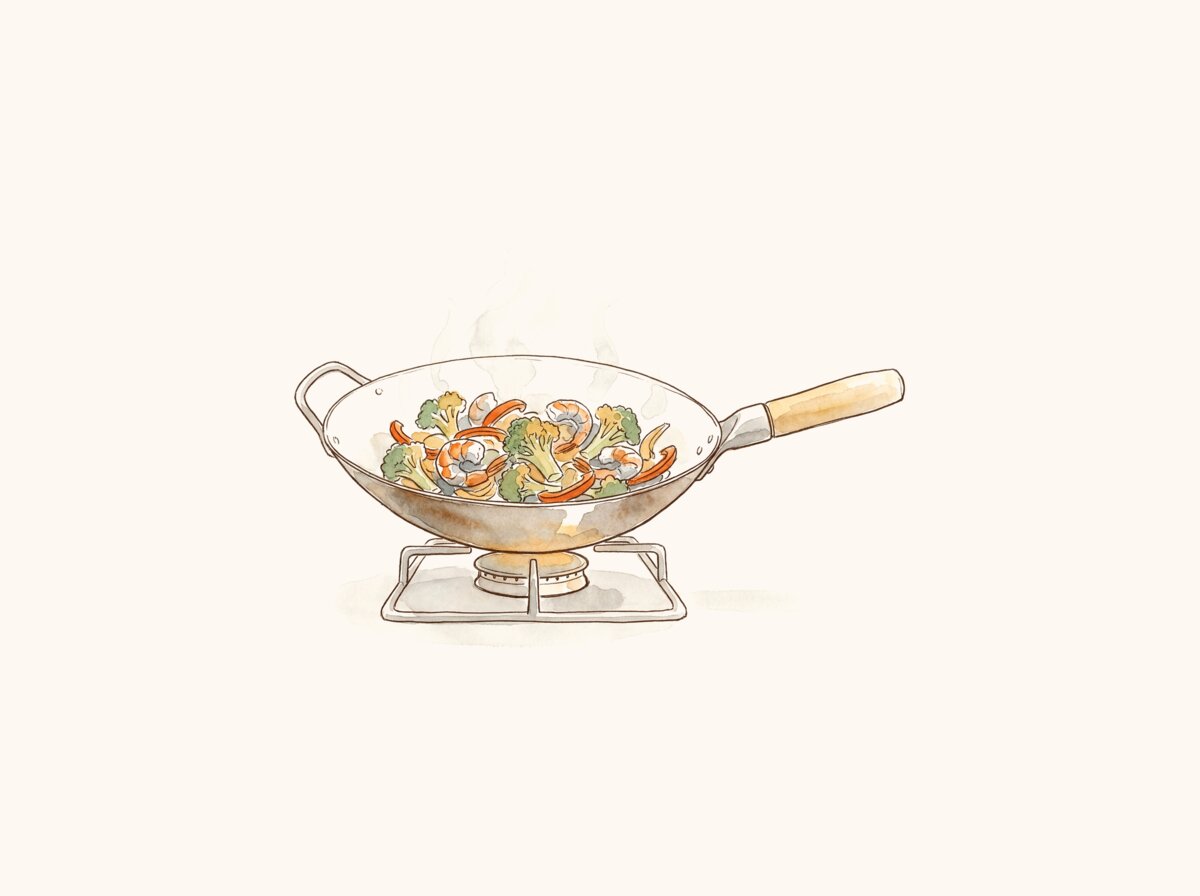
Wok Hei
The breath of the wok.
Takeaway stir-fry carries a smoky, almost barbecued perfume that home cooking rarely gets near. It has a name: wok hei, the breath of the wok. You're not missing an ingredient. You're missing what happens when food, oil and open flame meet in the same second.
Why it works
Oil flung off the food vaporises, catches fire above the pan, and rains back down carrying grill aromas.
Two things happen at once in a screaming wok. Thin steel at around 300 °C browns everything it touches in seconds instead of minutes. And oil thrown up the sloping side turns to a fine mist, meets the flame, and burns for an instant above the pan; those droplets fall back carrying the same aromas a charcoal grill gives. That's the smoke you can taste. It also explains why wok hei travels so badly to a home kitchen: 3 kW can't replace the heat a wok dumps into a load of cold vegetables, and an electric hob never touches the oil at all.
A restaurant wok burner runs fifteen to thirty times the power of a home gas ring, with a cold tap plumbed over each one so the chef can grab the handle. What you're doing at home is a scale model.
The moves
- 1
Preheat past the point that feels sensible
Dry wok, highest flame, three or four minutes. A bead of water should hit the metal and vanish, and the steel should show a faint blue haze.
- 2
Hot wok, cold oil
Swirl a tablespoon of oil right round the upper wall, then tip the excess out. That one move coats the whole cooking surface with a hot film, and it's the difference between a stir-fry and a welding accident.
- 3
Cook in humiliating small batches
A handful at a time. Two portions of chicken drop the steel below browning temperature, and everything after that is steam. Cook, tip out, repeat, combine at the end.
- 4
Toss, don't stir
Push and flick so the food rides up the hot side wall and falls back through the air. The wall browns it; the airborne half-second dries it.
- 5
Send the sauce down the side
Pour it round the rim, never into the middle. It hits screaming metal on the way down and caramelises. In the centre it just drowns the pan and pins it at 100 °C.
Save yourself
Reaching for the nonstick wok
PTFE breaks down above roughly 260 °C, below where wok hei even starts. Carbon steel, or settle for a very good sauté.
Tipping meat straight in from the marinade
Every drop of liquid buys you steam instead of browning. Lift it out, pat it dry, and save the marinade for the sauce.
Starting with the garlic and ginger
At these temperatures they're bitter in about thirty seconds. Aromatics go in for the last minute, or into the oil for five seconds before the main event.
Pop quiz
Where does the smoky aroma of wok hei actually come from?