Umami & The Synergy Trick
Why two savoury things beat one.
Some dishes taste of more than went into them. It's rarely a secret ingredient. Usually it's two ordinary ones multiplying each other, and umami is the only taste with a documented multiplication table.
Why it works
Glutamate gives savouriness. Add a nucleotide and the intensity multiplies instead of adding.
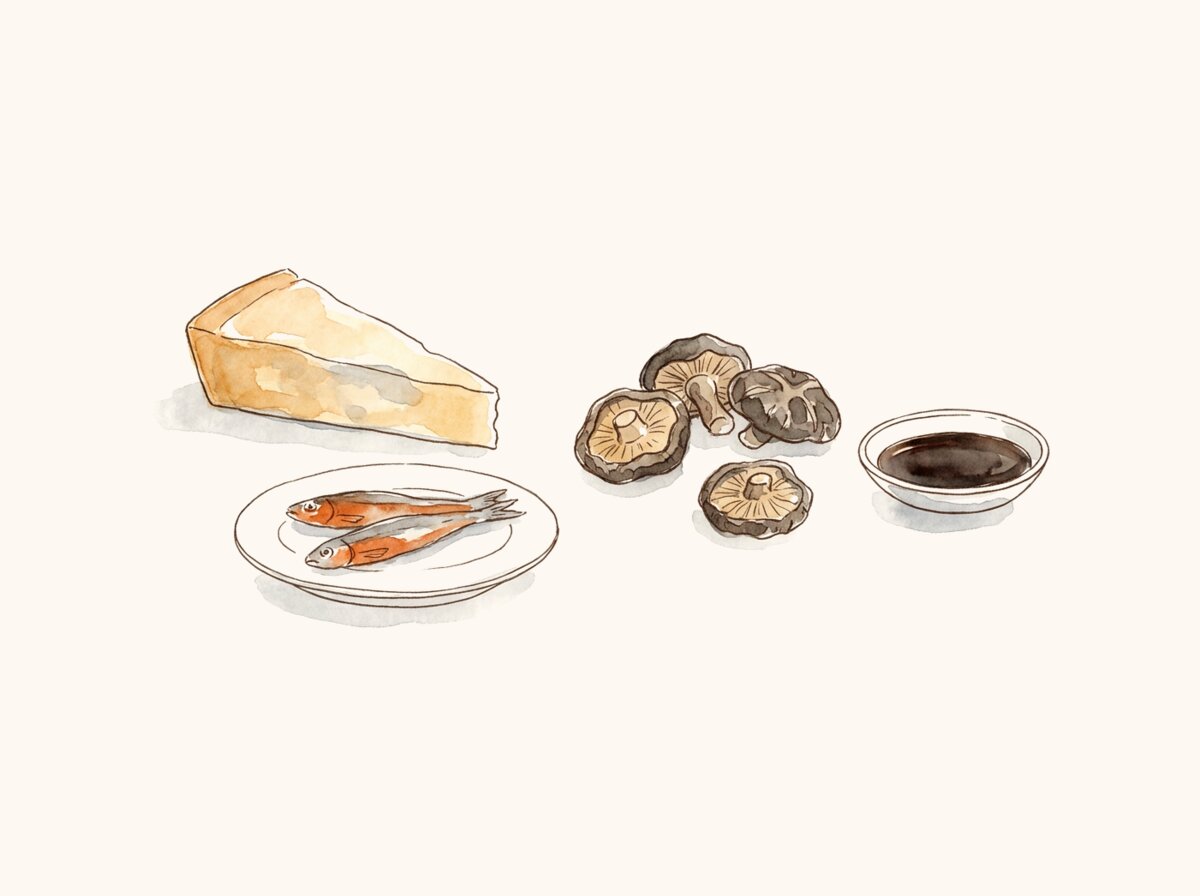
Umami comes from free glutamate: parmesan, soy, tomato, anchovy, mushroom, seaweed. On its own it's pleasant and slightly one-note. The trick is that the receptors respond far more strongly when glutamate arrives with a nucleotide: inosinate from meat and fish, guanylate from dried mushrooms. Together they read as several times more savoury than either alone. That's why dashi is kombu and bonito rather than either by itself, why a bolognese wants tomato and a parmesan rind, and why a mushroom sauce with a splash of fish sauce tastes like it simmered an extra hour. Drying concentrates both, so dried shiitake and sun-dried tomato punch well above their weight.
Kikunae Ikeda isolated glutamate from kombu in 1908 and named the taste umami. The multiplying effect wasn't pinned down until the 1960s, several centuries after Japanese cooks started putting kombu and bonito in the same pot.
The moves
- 1
Keep a glutamate shelf
Soy or fish sauce, tomato purée, a parmesan rind, dried mushrooms, miso, a tin of anchovies. None of them has to taste of itself in the finished dish.
- 2
Pair rather than pile
One glutamate source plus one nucleotide source: mushroom and soy, tomato and anchovy, kombu and bonito. Two chosen this way beat five thrown in.
- 3
Early for depth, late for lift
Anchovies and tomato purée want time in the pan to melt and darken. Fish sauce and miso go in near the end, off a hard boil, so their aroma survives.
- 4
Brown something first
The Maillard reaction builds its own savoury compounds. Deep browning plus one glutamate source is most of what separates a good weeknight dish from a flat one.
- 5
Taste for flatness, not for salt
If a dish is seasoned but dull, it usually wants umami or acid. Try half a teaspoon of fish sauce in a corner of the pan before you reach for the salt.
Save yourself
Treating MSG as something different from parmesan
It's the same molecule, and your tongue can't tell them apart. A pinch of MSG, a spoon of miso and a parmesan rind all move the same dial, so pick whichever suits the dish.
Boiling miso, soy or fish sauce hard
High heat drives off the aromatics and leaves the salt behind. Stir them in at the end, or off the heat entirely.
Adding five savoury things at once
Past a point it goes muddy and tastes of the store cupboard. Two ingredients, chosen to pair, is the whole technique.
Pop quiz
Why does dashi use kombu and bonito rather than either on its own?