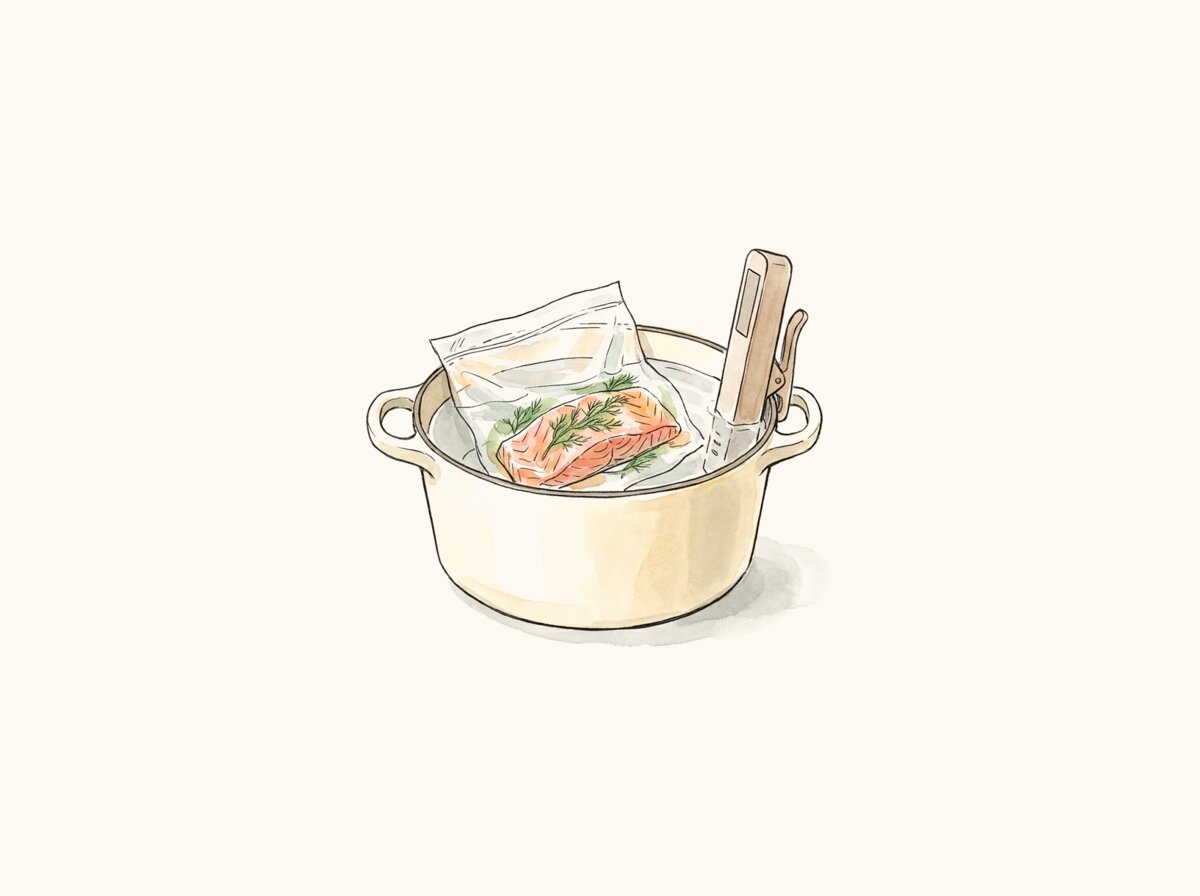
Sous Vide
Cooking with a thermostat.
Seal food in a bag, drop it in water held at exactly the temperature you want the food to reach, and walk away. It sounds like lab equipment. In practice it's the method that lets you stop watching the clock.
The water is the thermostat. The salmon settles at exactly 55 °C and then stops changing. There is no overcooked, only later.
Why it works
Water at exactly your target temperature makes overcooking physically impossible.
Water conducts heat about 23 times better than air, so a 55 °C bath brings a steak to 55 °C and then holds it there. The food can never get hotter than the water. That turns cooking from a race against the clock into equilibrium: temperature sets doneness, and time works quietly on texture, melting collagen into gelatin in tougher cuts.
Food safety is about time as much as temperature. Chicken held at 60 °C long enough is as pasteurised as chicken blasted to 74 °C.
The moves
- 1
Pick a temperature, not a time
Temperature is doneness: 55 °C is a textbook medium-rare steak, 63 °C a very soft egg. Time then shapes texture.
- 2
Season and bag
Salt and aromatics go in the bag. No vacuum sealer? Lower the open bag slowly into the water and the pressure squeezes the air out. Clip and seal.
- 3
Hold it there
A steak wants 1–2 hours; tough cuts want 24–48 while collagen melts. There's no rush, because the bath can't overcook it.
- 4
Dry, then sear violently
Out of the bag the surface is wet and pale. Pat it bone dry, then the hottest pan you own for seconds a side. You're adding crust, not cooking.
Save yourself
Searing long and gently afterwards
A long sear undoes the even doneness you just spent two hours on. Brutal and brief.
Watching the clock like a hawk
An extra 20 minutes changes nothing. That margin is the point of the method.
Skipping the dry-off before the sear
Wet surface, no crust. Pat it properly dry first.
Pop quiz
What happens to a 55 °C steak left an extra half hour in a 55 °C bath?