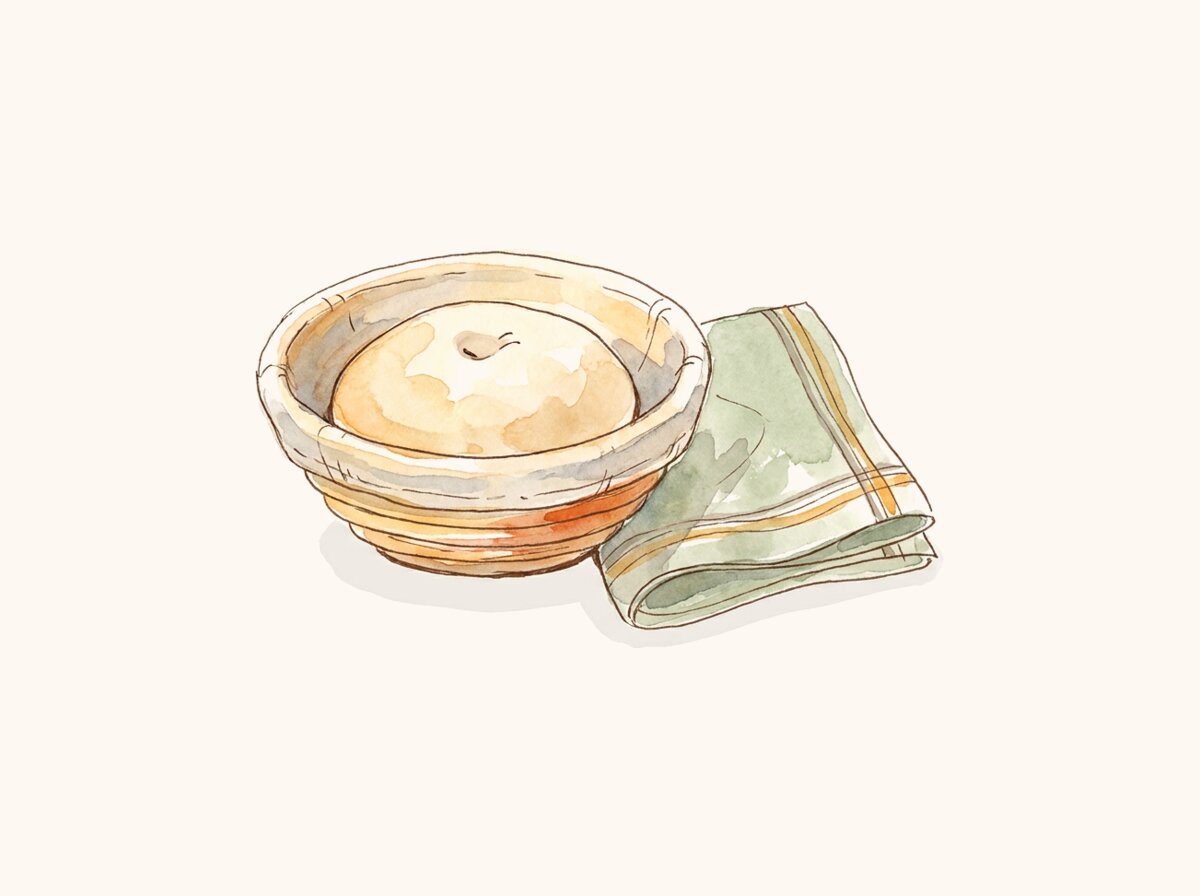
Proofing & the Poke Test
Listen to the dough, not the clock.
Between shaping and baking, dough is quietly inflating, and the window between not ready and collapsed is where most home bread is won or lost. The poke test turns that guesswork into a reading.
Why it works
Yeast fills the gluten net with gas; the poke test measures how much stretch the net has left.
During proofing, yeast ferments sugars into CO₂ that inflates the gluten network you built earlier. Underproofed dough still has plenty of elastic tension: poke it and it springs straight back, and in the oven it tears instead of rising evenly. Overproofed dough has stretched the net to its limit, so the dimple stays and the structure collapses under its own gas. Perfectly proofed sits between the two, and the dimple fills back slowly, about halfway.
Oven spring, that dramatic final rise, is the last blast of yeast activity plus expanding gas before the crust sets around 60 °C. It only happens if you left room for it.
The moves
- 1
Shape with tension
A taut, sealed surface gives the gas something to push against. Loose shaping proofs into a puddle no matter how good your timing is.
- 2
Watch volume, not minutes
Recipes say 1–2 hours because they can't see your kitchen. You're looking for roughly half again as big, puffy but not fragile.
- 3
Poke it
Flour a fingertip, press 2 cm in, and watch. Springs back instantly: wait longer. Fills back slowly, halfway: bake now. Stays put: into the oven immediately, gently.
- 4
Cold-proof for flavour
Overnight in the fridge slows the yeast but lets flavour-building bacteria keep working. Better bread on your schedule, baked straight from cold.
Save yourself
Trusting the recipe's clock
Temperature rules fermentation. The same dough takes 1 hour in a warm kitchen and 3 in a cold one. Poke, don't count.
Proofing somewhere drafty and dry
A skin on the dough traps the rise. Cover it, or proof inside the switched-off oven with a cup of warm water.
Punching down hard
A gentle fold preserves the gas structure you waited for. The dramatic punch belongs in old films.
Pop quiz
You poke the dough and the dimple springs back instantly. That means…