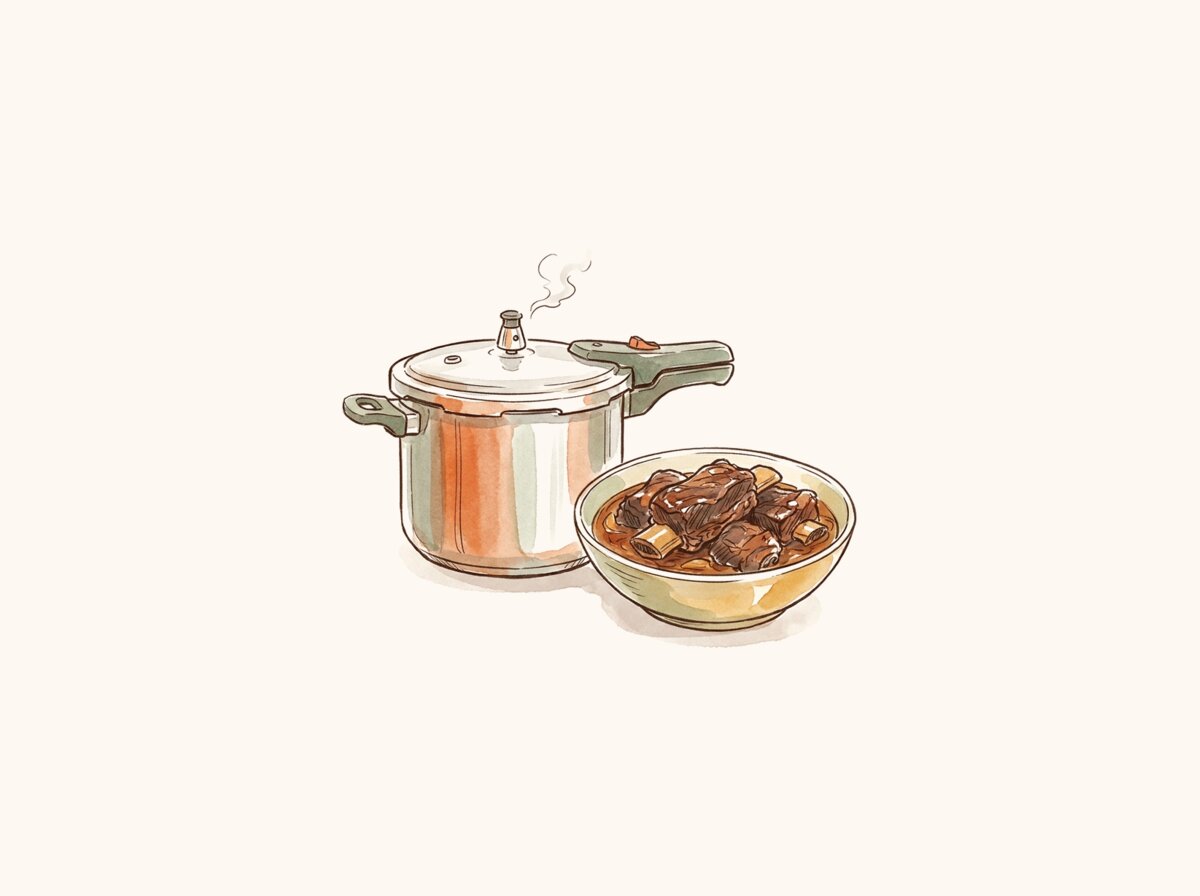
Pressure Cooking
Three hours of collagen in forty-five minutes.
Lock a lid down and water stops boiling at 100 °C. Everything that was going to take an afternoon now happens before dinner. It's the least romantic tool in the kitchen and the one that changes weeknights most.
Why it works
One bar of extra pressure lifts water's boiling point to about 121 °C, and reactions run roughly twice as fast for every 10 °C.
An open pot can't get past 100 °C, because every extra joule just boils water away. A sealed pot holds the steam, pressure climbs to about one bar above atmospheric, and the water reaches 121 °C before it boils. Twenty degrees counts for a lot when reaction rates climb this steeply: collagen that wants three hours at a simmer converts in about forty-five minutes. It also pushes a wet pot over the line where Maillard browning happens, so pressure-cooked stock tastes roasted. What you lose is evaporation. Nothing concentrates in a sealed pot, so sauces come out thin and want reducing with the lid off.
Denis Papin showed his steam digester to the Royal Society in 1682 by dissolving bones into an edible jelly. The safety valve he invented to stop it exploding is the same idea sitting on your lid.
The moves
- 1
Brown first, lid off
Sear in the same pot before you seal it. The pressure phase is a wet one: it melts and blends beautifully, but it'll never give you a crust.
- 2
Cut the liquid
Nothing evaporates, so a recipe written for the oven needs roughly half its liquid. Enough to raise steam and keep the base clear is enough.
- 3
Start the clock at pressure
Timing begins when the valve settles, not when you press the button. Beef shin 45 minutes, pork shoulder 50, dried chickpeas 35, chicken thighs 12, stock 90.
- 4
Choose the release deliberately
Natural release for meat, grains and pulses, because a fast drop boils liquid out of them and can shred a stew. Quick release for vegetables and anything you want stopped dead.
- 5
Finish with the lid off
Reduce the sauce, correct the seasoning, add the green and the fresh. This is where the dish gets its edges back.
Save yourself
Filling it to the brim
Two thirds full, and only half for foaming things like pulses and grains. Foam blocking the valve is the one failure that genuinely matters.
Using the braise recipe's liquid unchanged
None of it boils away, so the sauce arrives at the table diluted. Halve it going in, and reduce whatever's left at the end.
Opening early for a look
Every peek dumps the pressure and restarts the clock. Trust the timings, then simmer with the lid off if it needs more.
Pop quiz
Why does a pressure cooker cook so much faster?