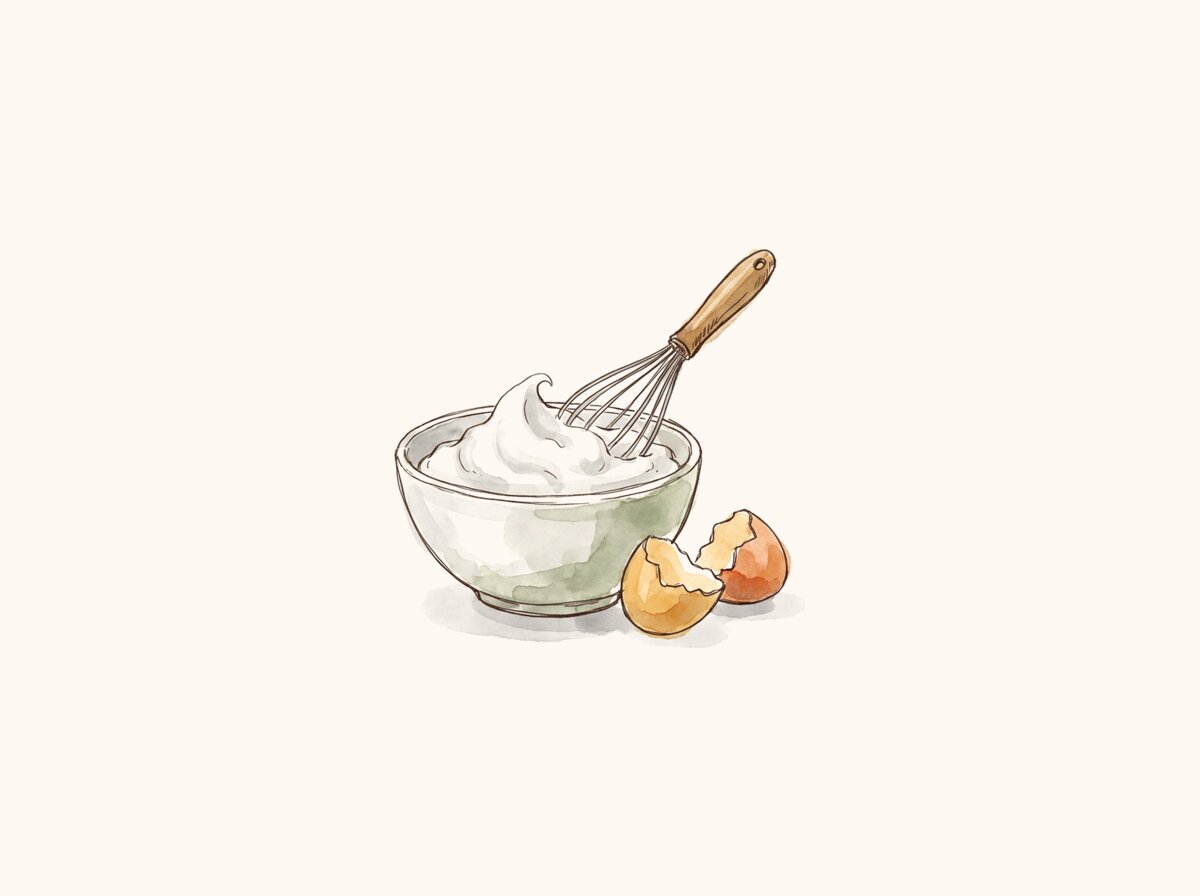
Meringues & Protein Foams
Egg white is water pretending to be architecture.
A meringue is one egg white, a lot of air, and enough sugar to hold the argument together. Understand what the whisk does to the proteins and mousses, soufflés and the one-drop-of-yolk disaster all explain themselves.
Why it works
Whisking unfolds the proteins so they link into walls around air bubbles. Sugar stabilises the walls; fat destroys them.
Egg white is about ninety percent water with proteins coiled up in it. Whisking unfolds those coils mechanically, and the unfolded strands bond to each other around every air bubble, building a wall that holds the air in. Sugar dissolves into the water between the bubbles and makes it viscous, slowing the drainage that would otherwise collapse the foam. Whip whites without sugar and they turn grainy and weep within minutes. Fat is the enemy: a trace of yolk or a greasy bowl coats the proteins and they never link at all. Acid and copper both make the network more forgiving, which is what a copper bowl has always been for.
The three classic meringues differ only in how the sugar arrives: raw for French, dissolved over a bain-marie for Swiss, boiling syrup for Italian. The syrup part-cooks the proteins on the way in, so Italian is the most stable of the three.
The moves
- 1
Start clean and fat-free
Wipe the bowl and whisk with vinegar or lemon. Separate each egg into a cup first, so one broken yolk can't take the whole batch down with it.
- 2
Room-temperature whites, slow start
Begin slowly until it's foamy and opaque, then go fast. Cold whites whip eventually but hold less air.
- 3
Sugar late and slowly
Wait for soft peaks, then rain it in a spoonful at a time. All at once and the whites never gain their volume back.
- 4
Whip to the rub test
Rub a little between your fingers. Gritty means undissolved sugar and a meringue that will weep. Smooth and glossy, with a peak that stands and curls slightly at the tip, is done.
- 5
Dry it, don't bake it
100–110 °C for hours rather than minutes. You're evaporating water, not browning. Then leave it to cool in the switched-off oven so it doesn't crack.
Save yourself
Whipping until it looks like cotton wool
That's overwhipped: the protein walls have gone rigid and started breaking. Fold in one fresh unwhipped white and bring it back.
Making meringue on a humid day
Sugar pulls water out of the air, so meringues go tacky in a damp kitchen. Dry them longer and box them airtight the moment they cool.
Using a plastic bowl
Plastic holds a film of fat that no washing-up removes. Glass, steel or copper.
Pop quiz
What's the sugar in a meringue mostly doing?