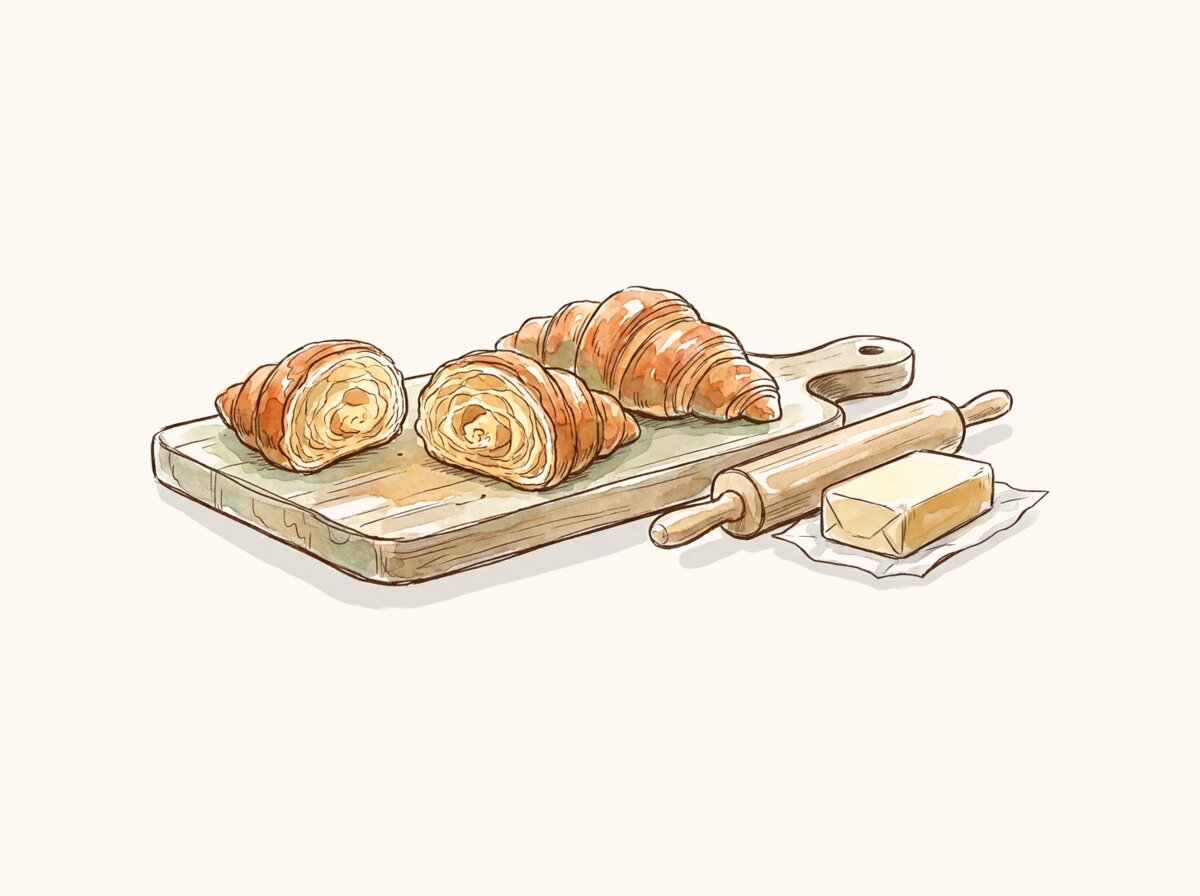
Lamination
Butter, dough, and a lot of steam.
A croissant is scores of alternating sheets of dough and butter, and the whole recipe is a fight to keep them apart until the oven arrives. Treat it as a temperature problem rather than a test of skill and it's perfectly doable at home.
Why it works
Sheets of butter waterproof the dough either side, then boil their own water into steam and push the layers apart.
Lamination is repeated folding: every turn triples the layers, so three turns give 27 and four give 81. What matters is that the butter stays in continuous sheets instead of mixing into the dough. In the oven those sheets melt and seal the dough on either side, and the roughly 16% water in butter turns to steam and inflates the gap, so every layer lifts the one above it. The technique lives in a narrow window: butter rolls like clay at about 16–18 °C, shatters into shards below that, and greases into the dough above about 26 °C. Colder isn't safer, which is the part that surprises people.
Puff pastry and croissants are the same physics with different leavening. Puff rises on steam alone and shatters; a croissant has yeast as well, so it pulls apart in strands.
The moves
- 1
Chill the dough, temper the butter
The butter block should bend without cracking. Bash it flat between two sheets of parchment while cold, then let it come up to that pliable point.
- 2
Match the two textures
Dough and butter must be equally firm. If one is stiffer than the other it tears through, and a tear anywhere is a lost layer everywhere.
- 3
Roll long, not wide
Even pressure, one direction, square corners. Ragged edges are layers that never separate.
- 4
Rest after every turn
Thirty to sixty minutes in the fridge between folds, so the gluten relaxes and the butter firms up again. Rushing a turn is what makes butter break through.
- 5
Prove cool, bake hot
Prove at 24–26 °C and no warmer, or the butter leaks out before it can steam. Then straight into a 200 °C oven, so the water flashes before the structure sets.
Save yourself
Using butter straight from the fridge
It shatters into chips rather than rolling into sheets, and chips give you a bready pastry with greasy pockets instead of layers.
Proving somewhere warm to save time
Above about 26 °C the butter melts and runs onto the tray. You'll know by the puddle and the flat, heavy result.
Flouring heavily between turns
Every stray layer of flour becomes a dry seam in the finished pastry. Brush the excess off before each fold.
Pop quiz
Why must the butter stay in continuous sheets rather than blend into the dough?