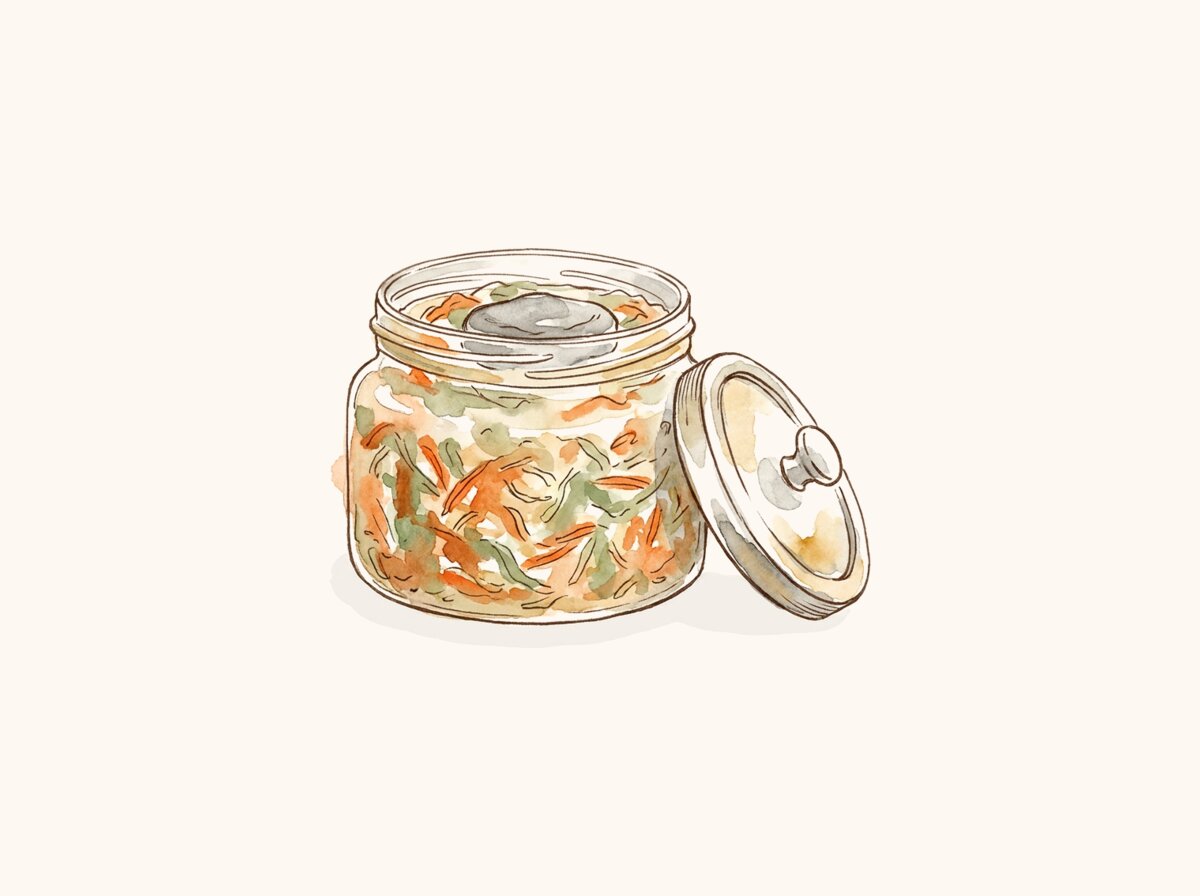
Lacto-Fermentation
Salt, water, patience, bubbles.
Sauerkraut, kimchi, sour pickles, hot sauce, half the world's condiments: vegetables, salt and time. No starter culture, no equipment, and the bacteria you need are already on the cabbage.
Why it works
Salt holds off spoilage while lactobacillus eats sugars and drops the pH below where anything dangerous can live.
Lactic acid bacteria are already on raw vegetables, along with everything else. A 2% brine is the referee: most spoilage organisms slow right down at that concentration while lactobacillus keeps working, so it wins the race and starts turning sugars into lactic acid. Once the pH falls below about 4.6 the jar is hostile to almost everything else, the organism behind botulism included, and the ferment is stable. Oxygen is the other lever. The bacteria you want work without it and the moulds you don't want need it, which is the whole reason everything has to stay under the brine.
The sourness is a by-product. The bacteria are busy making the jar uninhabitable for their competition, and we get pickles out of the argument.
The moves
- 1
Weigh everything, then salt at 2%
Weigh the vegetables and any water together, and add 2% of that weight in non-iodised salt. Guessing is the one reliable way to fail at this.
- 2
Bruise it or brine it
Shredded cabbage salted and squeezed makes its own brine in twenty minutes. Whole or chunky vegetables want a 2% brine poured over them instead.
- 3
Everything under the liquid
A weight, a folded cabbage leaf, a small bag of brine, whatever it takes. Anything poking into the air grows fuzz; anything submerged is safe.
- 4
Warm room, loose lid
18–22 °C is the sweet spot. The jar makes carbon dioxide and has to be able to burp, so leave the lid loose or open it once a day.
- 5
Start tasting on day three
Bubbles by day two, tart by day four, properly sour in one to three weeks. When you like it, tighten the lid and refrigerate. Cold slows it to a crawl.
Save yourself
Guessing the salt
Too little gives soft, off-smelling mush; too much stalls the ferment completely. Two percent of the total weight, on a scale, every time.
Panicking at cloudy brine and fizz
That's the ferment working. White cloudiness and bubbles are exactly right. Fuzzy or coloured mould isn't, and it only ever grows on what's sticking out of the brine.
Sealing the jar tight
The carbon dioxide has to go somewhere. A properly sealed jar either burps itself violently at the worst possible moment or cracks.
Pop quiz
What's the salt actually doing in a lacto-ferment?