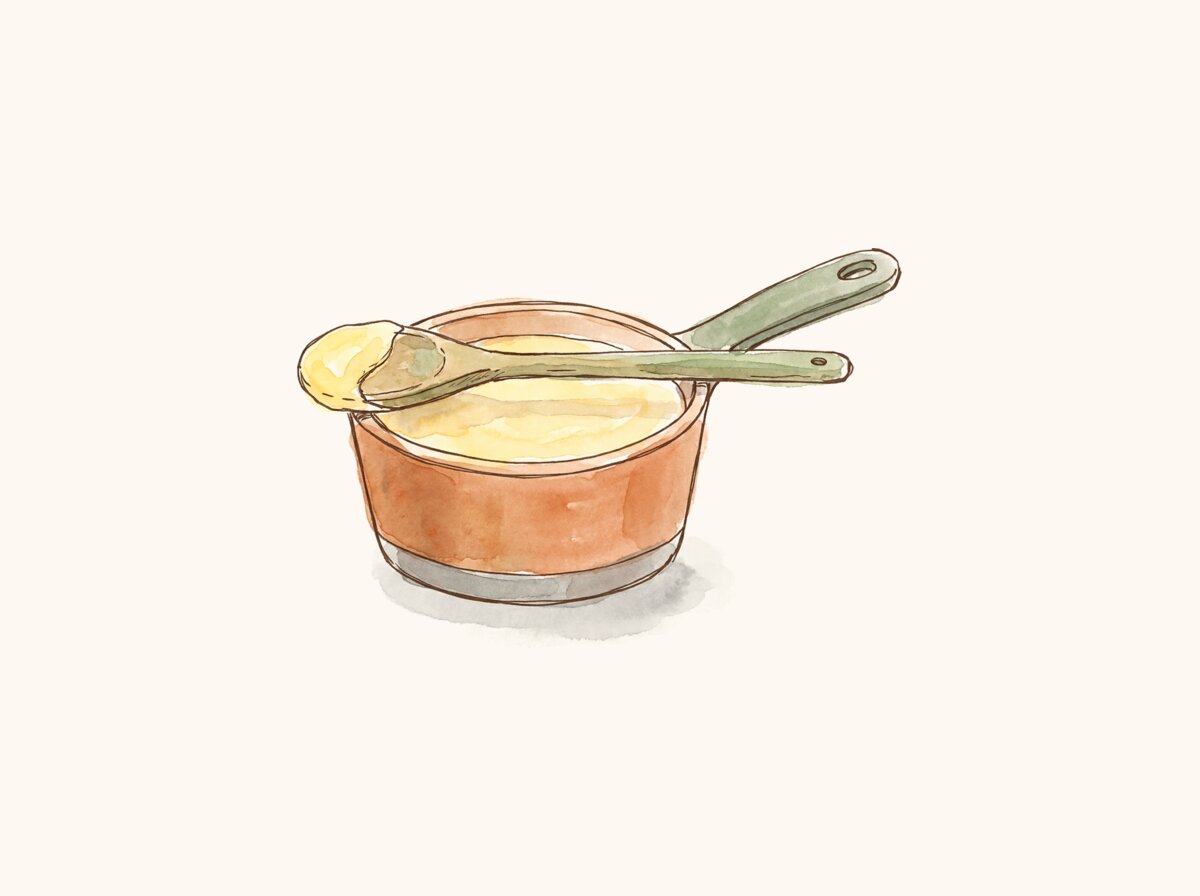
Custard & Coagulation
Eggs set at a temperature, not at a time.
Crème anglaise, lemon curd, quiche, carbonara, ice cream base. One skill sits under all of them: eggs thicken a liquid across a narrow band of temperature and scramble just above it. A thermometer turns the whole family from a gamble into a routine.
Why it works
Egg proteins unfold and link into a mesh from about 65 °C. A few degrees more and the mesh wrings its liquid out.
Heat unfolds egg proteins so they bond to one another, trapping the liquid around them in a soft mesh. That's thickening. Yolks begin setting around 65 °C and are done near 80. Push past the band and the mesh keeps tightening, squeezes the water out, and separates into curds swimming in liquid, which is scrambling. Two things widen the safe window. Sugar gets between the proteins and raises the setting point, and starch physically blocks them from over-bonding, so pastry cream can be boiled without fear while crème anglaise can't. Dilution helps too: more milk means a later, gentler set.
The classic test is a way of reading 82 °C without a thermometer: draw a finger through the custard on the back of a spoon, and the line holds.
The moves
- 1
Temper, never dump
Pour the hot liquid into the eggs in a thin stream, whisking the whole time. Eggs added to a hot pan cook where they land.
- 2
Low heat, constant motion
A spatula scraping the corners of the pan. Anywhere you're not stirring is several degrees hotter than the rest.
- 3
Go by temperature
82–84 °C for a pouring custard, 78–80 °C for an ice-cream base. Off the heat the moment it arrives, because it keeps climbing in the pan.
- 4
Know when starch changes the rules
Pastry cream and lemon curd contain starch, so they have to boil for a full minute. That thickens them properly and destroys an enzyme in the yolks that would otherwise thin them again in the fridge.
- 5
Strain, then cool fast
Through a sieve into a cold bowl, with cling film on the surface. The sieve catches the few strands that always set, and fast cooling stops residual heat finishing the job for you.
Save yourself
Walking away for ten seconds
The gap between thickened and scrambled is about two degrees and twenty seconds. Custard is a stand-there job.
Boiling a crème anglaise because the pastry cream survived it
Starch is the whole difference. Without it, nothing keeps the proteins apart and it curdles.
Throwing out a split custard
Hit it with a stick blender, or strain it and whisk it into a spoonful of cold cream. Most splits come back.
Pop quiz
Why can pastry cream be boiled when crème anglaise can't?