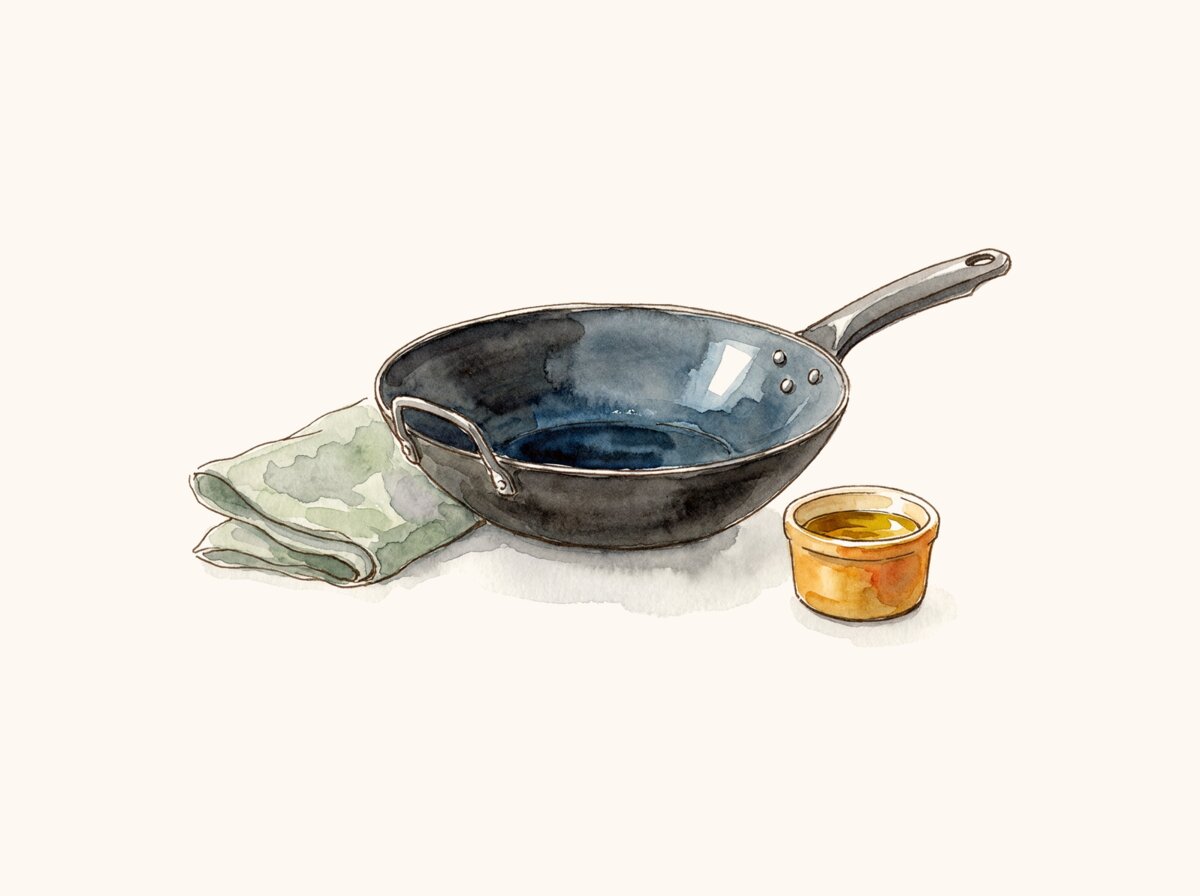
Seasoning Carbon Steel
Build a black mirror, then never scrub it off.
A new wok turns up silver, sticky and hopeless. Everything welds to it. An hour of deliberate abuse turns that same metal into the slickest pan you own, and unlike a coated one it gets better every year.
Why it works
Oil wiped almost dry, heated past its smoke point, hardens into a plastic bonded to the iron.
Seasoning is oil that's changed state. Push a very thin film past its smoke point and the fat breaks apart and links up into a tough polymer that grips the iron's microscopic texture. Thin is the whole trick: a film you can still see stays liquid underneath and bakes into sticky brown varnish, while a film wiped back to nothing sets like glass. Every round adds a layer, so an old wok is blacker, slicker and far more forgiving than a new one.
The same reaction cures linseed oil into a hard finish on furniture. Your wok is varnished, with cooking oil.
The moves
- 1
Burn off the factory coat
New carbon steel ships under a lacquer so it survives the warehouse. Open a window, dry pan on the biggest flame, and walk it across the heat until the shine goes and the metal turns straw, then blue.
- 2
Wipe on almost nothing
A teaspoon of grapeseed, canola or refined peanut oil over every surface, outside included, then wipe it back with a clean towel until the pan looks dry. If you can see oil, there's too much.
- 3
Heat past the smoke
Take it up until the smoking stops. That's the polymer setting. Cool, repeat three or four times, and the colour walks from straw through bronze to near-black.
- 4
Cook fat first
Give young seasoning easy meals: fried eggs, bacon, stir-fried peanuts. Tomato, wine and lemon strip a thin layer straight back off, so leave those a fortnight.
- 5
Dry it on the fire
Hot water and a soft brush, then straight back on the burner until the last drop steams off. Water kills carbon steel, not soap.
Save yourself
Pouring in a visible layer of oil to season
Thick oil bakes into sticky brown patches that flake into your food. Wipe until the pan looks dry, then wipe it again.
Leaving it to air-dry after washing
Rust blooms overnight in the last invisible film of water. Thirty seconds back on the heat and it can't.
Treating a bare grey patch as ruin
A grey patch is just missing polymer. Oil it, heat it past smoking, carry on. It's the only pan you can repair with a paper towel.
Pop quiz
Why does seasoning need an almost invisible film of oil?