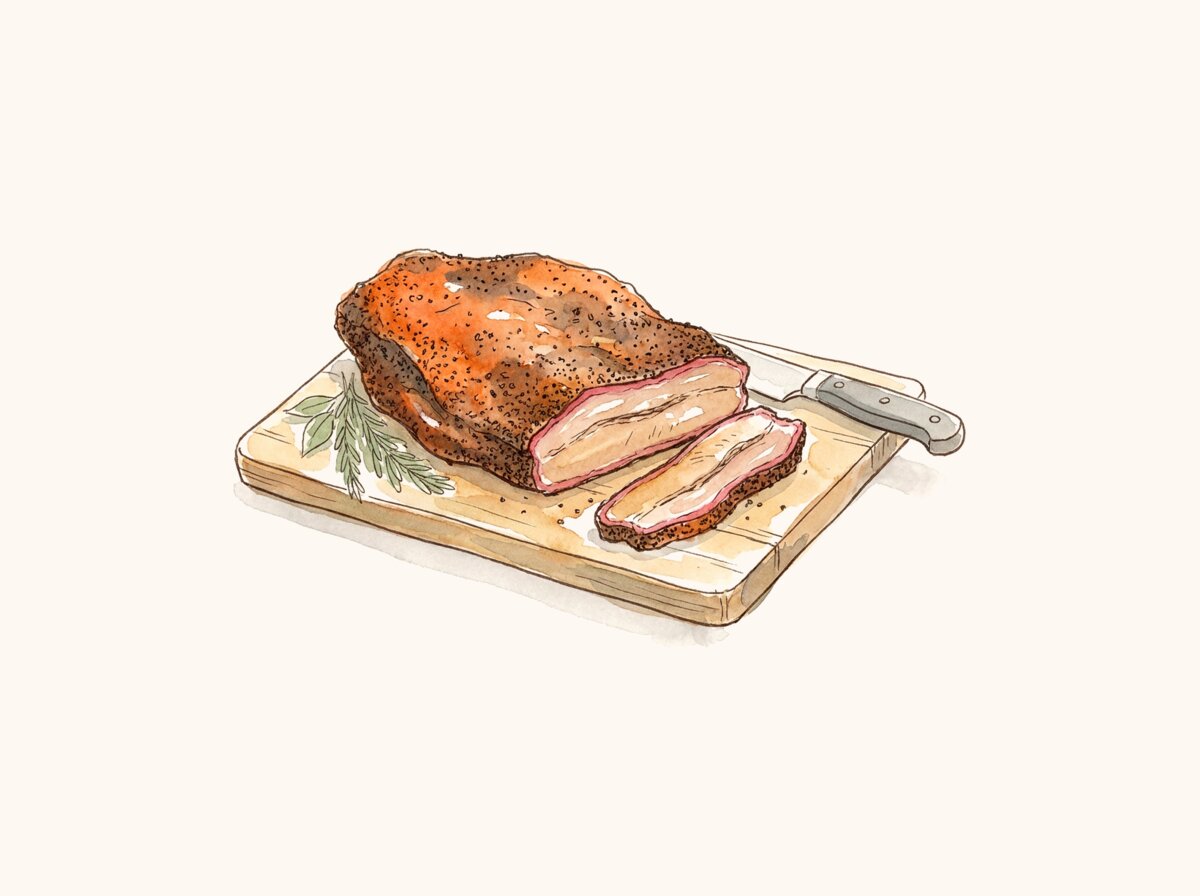
Smoke, Bark & The Stall
Six hours in, the thermometer stops. Don't panic.
Low-and-slow barbecue has three mysteries. Why the crust goes black and delicious instead of burnt. Why there's a pink ring under it that isn't undercooked meat. And why, halfway through, the temperature parks at 70 °C and refuses to move for three hours.
Both briskets get there. The unwrapped one spends three hours sweating at 70 °C on the way, and earns a better bark for it.
Why it works
The stall is evaporative cooling: the meat sweats away energy as fast as the smoker delivers it.
People blamed collagen for years. The truth is stranger. A big piece of meat in dry smoke behaves like a wet-bulb thermometer: moisture wicks to the surface and evaporates, and evaporation carries off almost exactly as much energy as the fire puts in, so the meat sits there sweating until the surface finally dries and the climb resumes. Two other things happen while you wait. The bark is Maillard browning fusing with dried rub and smoke into a crust. And nitric oxide from the burning wood reacts with myoglobin just under the surface and fixes it pink for good, so the smoke ring is chemistry, not doneness.
You can fake a smoke ring with a pinch of curing salt, and competition judges are told not to score it. The least trustworthy thing on the plate.
The moves
- 1
Rub early, dry the surface late
Salt and rub hours ahead so it dissolves and draws moisture out, then let the surface dry before it goes on. Wet meat takes smoke but never builds bark.
- 2
Chase thin blue smoke
Billowing white smoke is smouldering fuel and it tastes like an ashtray. You want a clean, hot fire whose smoke is barely visible.
- 3
Hold 110–120 °C and stop opening the lid
Every look costs about fifteen minutes of recovery. Put a probe in at the start and read it from outside.
- 4
Ride out the stall, or wrap through it
Wait it out for the best bark, or wrap at around 70 °C to shut evaporation down and finish two hours sooner. Foil is faster and softens the crust; butcher paper breathes and keeps more of it.
- 5
Finish by feel, somewhere near 95 °C
Brisket and pork shoulder are done when the probe slides in like warm butter, usually 93–96 °C. Then rest it wrapped for an hour, minimum.
Save yourself
Turning the heat up when the stall hits
More heat means more evaporation, so the stall holds and the outside dries into leather. Wait, or wrap.
Pulling at a number instead of at a feel
Every brisket gives up at its own temperature. Probe several spots and go by resistance, not by the reading.
Slicing it straight off the smoker
An unrested brisket floods the board. An hour in a warm cooler lets the gelatin thicken and the juices settle back into the meat.
Pop quiz
What actually causes the stall?