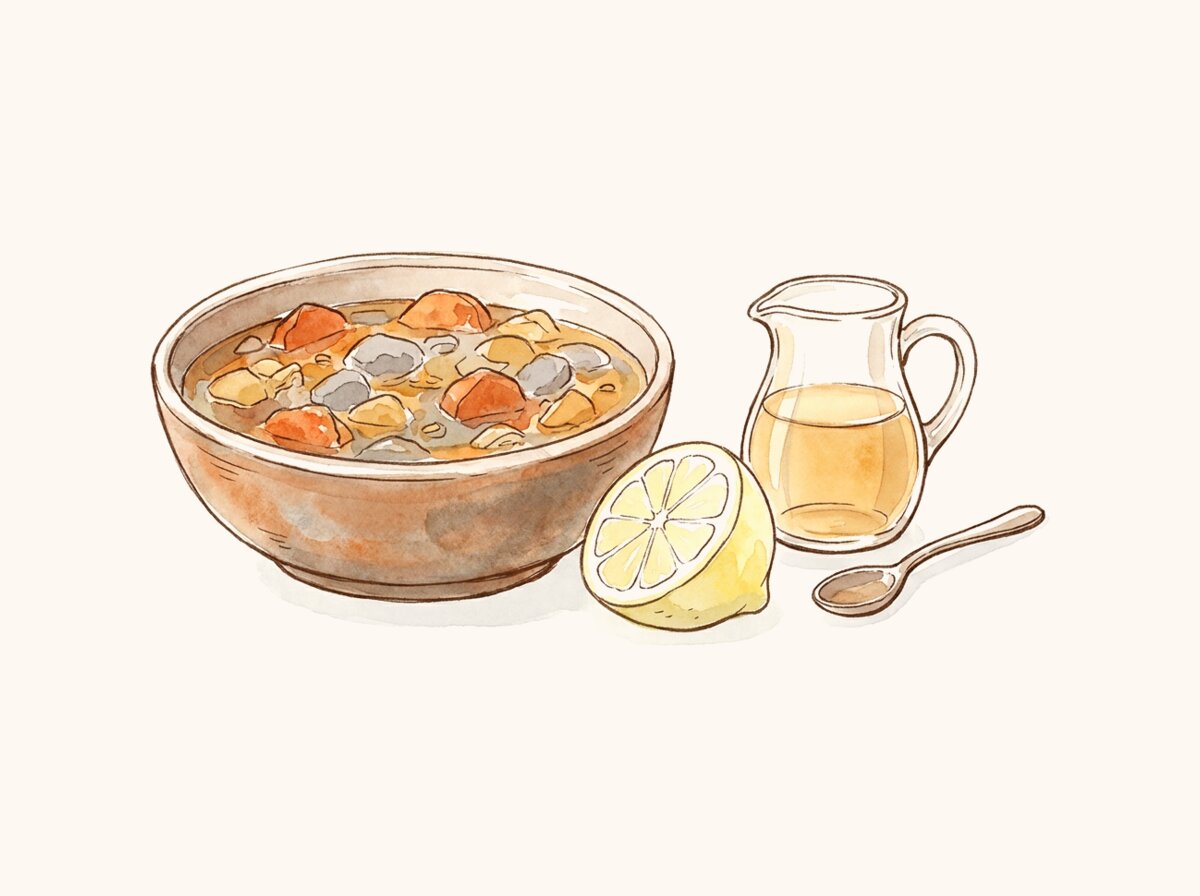
Acid & Balance
The fix for "it needs something".
The commonest problem in home cooking is a dish that's perfectly fine and somehow flat. Nine times out of ten it isn't underseasoned, it's unbalanced, and what's missing is acid.
Why it works
Acid sharpens every other taste and cuts against fat, so a dish reads bright instead of heavy.
Salt, fat, acid and sweetness all change how the others land. Acid earns its keep twice: it contrasts with fat, which otherwise flattens everything into richness, and it makes savouriness and sweetness read as defined rather than muddy. It moves physically too. A squeeze of lemon over a finished braise sits on top and hits first; vinegar simmered in for an hour disappears into the background as depth. Heat drives off the volatile part, so a long-cooked dish nearly always needs a correction at the end that no amount of early seasoning can supply.
Salt suppresses bitterness and acid amplifies it. A pinch of salt rescues over-bitter greens; lemon makes over-steeped coffee worse.
The moves
- 1
Taste for the gap, not for the salt
Three questions in order: is it seasoned, is it flat, is it heavy? Flat wants acid. Heavy wants acid. Only genuinely bland wants salt.
- 2
Match the acid to the dish
Lemon for fish, greens and anything creamy. Vinegar for braises, beans and fried food. Wine and tomato are cooking acids, built in from the start rather than added at the end.
- 3
Add it a quarter teaspoon at a time
Acid moves fast and is hard to walk back. Add, stir, taste, repeat. You're looking for the point where everything sharpens, not the point where it tastes sour.
- 4
Keep some back for the end
Whatever went in early has mostly boiled away. The last teaspoon, stirred in off the heat, is the one people notice.
- 5
Know the other levers
A pinch of sugar softens an acid that overshot, fat rounds it off, and salt pulls the rest back into focus. Overshooting is recoverable if you reach for the right one.
Save yourself
Reaching for salt whenever a dish tastes dull
The usual result is a salty dish that's still dull. Try acid first. You can always salt afterwards, and you can't unsalt.
Putting all the lemon in at the start of a long braise
It cooks away to nothing. Build with wine or vinegar early, finish with fresh juice.
Fixing an over-sour sauce with salt
Salt sharpens it further. Sugar, a spoon of cream, or plain dilution are the ways back.
Pop quiz
A rich braise tastes properly seasoned but flat and heavy. What's the first move?